

What Is Collagen Supplement ODM?
Collagen supplement ODM refers to a development and manufacturing model where a specialized partner helps a brand create collagen products from concept to finished goods. ODM stands for Original Design Manufacturer. In the supplement industry, this usually means the manufacturer does more than simply produce a formula provided by the client. A collagen supplement ODM partner may support product positioning, ingredient selection, formula development, dosage format planning, flavor adjustment, packaging suggestions, quality testing, and production execution.
For brands entering the beauty-from-within, healthy aging, joint support, sports nutrition, or daily wellness market, collagen supplement ODM can reduce development pressure. Instead of building a complete R&D, sourcing, manufacturing, and compliance team from the beginning, the brand can work with an experienced partner that already understands collagen raw materials, manufacturing processes, market preferences, and practical production limitations.
Who Is Collagen Supplement ODM Suitable For?
Collagen supplement ODM is suitable for startups, beauty brands, wellness companies, nutrition brands, clinics, e-commerce sellers, distributors, and established consumer goods companies that want to launch collagen-related products without managing every technical detail internally. It is especially useful when a company has a clear target audience but needs help turning that market idea into a stable, manufacturable, and commercial product.
Common collagen product formats include powder sachets, stick packs, capsules, tablets, gummies, ready-to-drink beverages, liquid shots, jelly sticks, and functional drink mixes. Each format has different requirements for taste, solubility, stability, production equipment, packaging compatibility, shelf life, and MOQ. A capable ODM partner helps the brand choose a format that fits both market demand and operational feasibility.
Why Do Brands Need Collagen Supplement ODM?
The collagen market is competitive. Consumers are no longer satisfied with basic products that only say “collagen” on the label. They compare collagen source, peptide size, dosage, added nutrients, sugar level, flavor, convenience, certifications, packaging design, and brand story. For this reason, collagen supplement ODM is not just about manufacturing. It is about creating a product that is technically workable, commercially attractive, and aligned with consumer expectations.
1. Brands Need Faster Product Development
Developing a collagen supplement from scratch can take a long time if a brand has to find raw materials, test formulas, locate packaging vendors, compare factories, and review production feasibility independently. An ODM partner can shorten the path by offering existing development experience, sample formulas, supplier networks, and practical manufacturing knowledge.
2. Collagen Formulation Requires Technical Judgment
A good collagen formula is not created by adding many trendy ingredients together. The formula must consider taste, texture, solubility, dosage, ingredient interaction, cost, serving size, production method, and label clarity. For example, collagen peptides may be combined with vitamin C, hyaluronic acid, elastin, ceramides, antioxidants, or minerals depending on the product positioning. However, every additional ingredient affects cost, flavor, stability, and claims strategy.
3. Packaging and Dosage Format Affect Sales
Packaging is not only visual design. It affects convenience, shelf life, shipping cost, user experience, and perceived value. A collagen powder in a jar may fit daily home use, while stick packs are better for portability and premium gifting. Gummies may appeal to younger consumers, while capsules may suit users who prefer simple routines. Collagen supplement ODM helps brands match format and packaging to real consumption behavior.
4. Quality Control Is Critical for Brand Trust
Supplement buyers care about quality, consistency, and safety. Even when a product has strong branding, poor taste, clumping powder, unstable texture, unclear labeling, or inconsistent batches can damage consumer confidence. A reliable ODM process should include raw material verification, production control, finished product testing, documentation, and batch traceability.
How Does Collagen Supplement ODM Work?
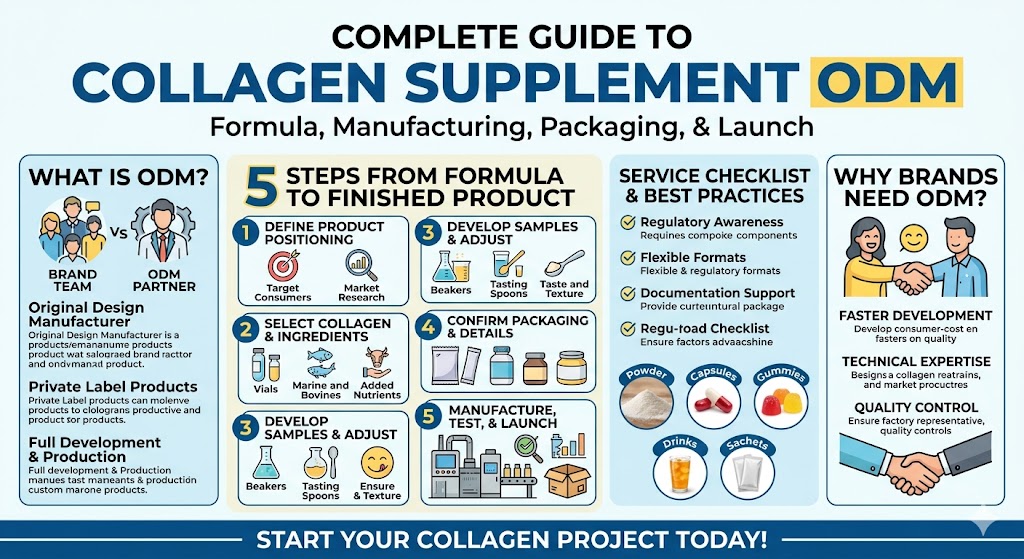
A professional collagen supplement ODM project usually follows a structured process. The exact workflow may vary by manufacturer, product format, market, and order size, but most successful projects include the following five steps.
Step 1: Define Product Positioning and Target Consumer
The first step is not formulation. It is positioning. The brand should define who the product is for, what problem it addresses, what price range it targets, and how it will be sold. A collagen product for premium beauty consumers will not be designed the same way as a sports recovery product, a mass-market powder, or a clinic-exclusive supplement.
Step 2: Select Collagen Source and Supporting Ingredients
Collagen may come from marine, bovine, porcine, or chicken sources, depending on product direction, consumer preference, cost, and market restrictions. Marine collagen is often used in beauty products, while bovine collagen is common in broader wellness and nutrition categories. Supporting ingredients should be selected based on product logic, not only marketing appeal.
Step 3: Develop Samples and Adjust Taste, Texture, and Dosage
Sampling is where the concept becomes real. For powder products, solubility, sweetness, aftertaste, aroma, color, and mouthfeel need to be tested. For gummies or jelly sticks, texture and stability become more important. For capsules, serving size and daily dosage matter. The ODM team should help balance consumer experience with formula practicality.
Step 4: Confirm Packaging, Labeling, MOQ, and Production Details
Before mass production, the brand and ODM partner should confirm packaging materials, unit count, label information, carton specifications, minimum order quantity, lead time, testing items, and delivery requirements. This stage prevents misunderstandings later. Many delays happen because packaging artwork, label content, or production specifications are not finalized early enough.
Step 5: Manufacture, Test, Pack, and Prepare for Launch
Once the final formula and packaging are approved, the product moves into production. A good collagen supplement ODM partner should manage manufacturing procedures, in-process control, finished product inspection, batch documentation, and packaging checks. After production, the brand can prepare sales pages, education content, influencer materials, product photography, and launch campaigns.
Collagen Supplement ODM Service Checklist
| ODM Stage | What to Check | Why It Matters |
|---|---|---|
| Concept Planning | Target audience, price point, sales channel, product format | Keeps the formula aligned with commercial goals |
| Ingredient Selection | Collagen source, dosage, supporting nutrients, ingredient quality | Affects positioning, cost, taste, and consumer trust |
| Sample Development | Flavor, texture, solubility, sweetness, serving size | Determines repeat purchase and user satisfaction |
| Packaging | Bottle, sachet, jar, pouch, box, label, carton | Influences shelf appeal, logistics, and brand image |
| Production | MOQ, lead time, batch control, testing, documentation | Reduces operational risk and protects product consistency |
Common Mistakes When Choosing a Collagen Supplement ODM Partner
- Choosing only by lowest price: Low cost can become expensive if the product has poor taste, weak packaging, unstable quality, or production delays.
- Ignoring formula logic: Adding too many trendy ingredients may create a crowded formula without clear positioning.
- Not confirming MOQ early: Minimum order quantity affects budget, inventory risk, and launch planning.
- Overlooking packaging compatibility: Some formulas may not suit certain packaging due to moisture, stability, or serving-size limitations.
- Skipping sample evaluation: A formula that looks good on paper may fail because of taste, smell, texture, or aftertaste.
- Using unclear label claims: Supplement claims should be reviewed carefully to avoid misleading or risky communication.
- Failing to plan launch content: Even a good product needs education, comparison points, product pages, and sales materials.
Best Practices for a Successful Collagen Product
1. Build the Product Around a Clear Consumer Need
A successful collagen supplement should have a clear reason to exist. Is it for beauty maintenance, daily wellness, convenient nutrition, premium gifting, active lifestyle support, or mature consumers? Clear positioning makes formula decisions easier and helps marketing messages feel more focused.
2. Prioritize User Experience
Consumers must be willing to use the product repeatedly. For powder products, taste and solubility are critical. For capsules, pill size and daily serving count matter. For gummies and jellies, texture and sweetness are major factors. Repeat purchase often depends on whether the product fits easily into daily routines.
3. Ask for Documentation and Testing Support
A trustworthy collagen supplement ODM partner should be able to explain raw material documentation, production controls, quality checks, and batch-related records. Documentation is important for internal review, distributor communication, regulatory preparation, and long-term brand trust.
4. Design Packaging With Both Marketing and Operations in Mind
Beautiful packaging is important, but it must also be practical. Consider storage, shipping, carton size, protection from moisture, label readability, and retail display. Packaging decisions directly affect cost, customer experience, and supply chain efficiency.
5. Prepare Education-Based Marketing Before Launch
Collagen buyers often want to understand the source, dosage, benefits, usage method, and product difference before purchasing. Brands should prepare product pages, FAQ content, comparison charts, ingredient explanations, and usage guides before launch. A strong ODM product still needs strong communication to convert traffic into orders.
Conclusion and Next Step
Collagen supplement ODM is a practical path for brands that want to launch collagen products with better speed, structure, and manufacturing support. Instead of treating ODM as only a factory service, brands should view it as a development partnership that connects market positioning, formula design, ingredient selection, sample testing, packaging, production, and launch preparation.
Before choosing a collagen supplement ODM partner, review their formulation ability, production experience, quality control process, communication efficiency, documentation support, packaging options, and ability to understand your target market. A better partner does not simply produce what you request; they help you identify risks, refine the product, and turn an idea into a commercially viable supplement.
CTA: If you are planning to launch collagen powder, capsules, gummies, sachets, jelly sticks, or functional drinks, prepare your target audience, desired format, price range, ingredient direction, and expected order quantity before contacting an ODM partner. This will make the development conversation faster and more productive.
Collagen Supplement ODM FAQ
Q1: What does collagen supplement ODM mean?
Collagen supplement ODM means a manufacturer helps develop and produce collagen products based on a brand’s market needs. The service may include formula design, ingredient sourcing, sample testing, packaging planning, manufacturing, and quality control.
Q2: What is the difference between ODM and OEM for collagen supplements?
OEM usually means the brand provides the formula and the factory manufactures it. ODM usually includes more development support, such as formula planning, sample creation, ingredient recommendations, and packaging suggestions.
Q3: What collagen product formats can an ODM manufacturer produce?
Common formats include collagen powder, stick packs, sachets, capsules, tablets, gummies, jelly sticks, liquid shots, and ready-to-drink products. The best format depends on target users, budget, dosage, taste, and sales channel.
Q4: How do I choose a collagen supplement ODM partner?
Check their experience with collagen formulas, production capability, sample development process, quality control, documentation support, packaging options, communication speed, and ability to understand your target market.
Q5: What information should I prepare before contacting an ODM supplier?
Prepare your target audience, product format, expected price range, ingredient preferences, packaging idea, estimated order quantity, sales market, and launch timeline. This helps the ODM team suggest realistic solutions.
Q6: Is marine collagen better for ODM beauty supplements?
Marine collagen is commonly used in beauty-positioned supplements because it fits consumer expectations in many beauty markets. However, the best choice still depends on cost, target region, formula design, and brand positioning.
Q7: Can an ODM manufacturer help with flavor development?
Yes. Many collagen supplement ODM partners help adjust flavor, sweetness, aroma, aftertaste, solubility, and texture. This is especially important for powders, drinks, gummies, and jelly products.
Q8: What affects the MOQ of collagen supplement ODM projects?
MOQ depends on product format, packaging type, ingredient sourcing, production line requirements, formula complexity, and customization level. Custom packaging and special ingredients usually increase the minimum order quantity.
Q9: How long does it take to develop a collagen ODM product?
The timeline varies by formula complexity, sample revisions, packaging confirmation, testing requirements, and production schedule. Projects with custom flavors, new packaging, or imported ingredients usually require more planning time.
Q10: Why is collagen supplement ODM important for private label brands?
ODM helps private label brands reduce development risk, improve product quality, speed up launch planning, and create formulas that are easier to manufacture and sell. It is useful for brands without a full internal R&D team.
 膠原蛋白粉代工怎麼選?OEM vs ODM 差異一次看