

Introduction
In industrial environments, doors are not just simple entry points. They are critical components that affect operational efficiency, security, safety, insulation, and long-term maintenance costs. This is why many factories, warehouses, logistics centers, and commercial facilities rely on HEAVY DUTY DOORS designed for high-frequency operation and demanding environments.
Compared with standard doors, HEAVY DUTY DOORS are built with stronger materials, reinforced structures, and more durable hardware systems. They are designed to withstand repeated use, heavy impact, changing weather conditions, and industrial workloads. In this guide, we will explain the different types of HEAVY DUTY DOORS, common applications, material options, installation considerations, and future industry trends.
Table of Contents
- Section 1: What Is a HEAVY DUTY DOOR and Why Is It Commonly Used in Industrial Spaces?
- Section 2: What Types of HEAVY DUTY DOORS Are Available?
- Section 3: What Materials Are Commonly Used for HEAVY DUTY DOORS?
- Section 4: Where Are HEAVY DUTY DOORS Commonly Used?
- Section 5: How to Choose the Right HEAVY DUTY DOOR?
- Section 6: HEAVY DUTY DOOR Installation and Maintenance Tips
- Section 7: Future Trends and Smart Technology in HEAVY DUTY DOORS
- FAQ
Section 1: What Is a HEAVY DUTY DOOR and Why Is It Commonly Used in Industrial Spaces?
1. The basic definition and purpose of a HEAVY DUTY DOOR
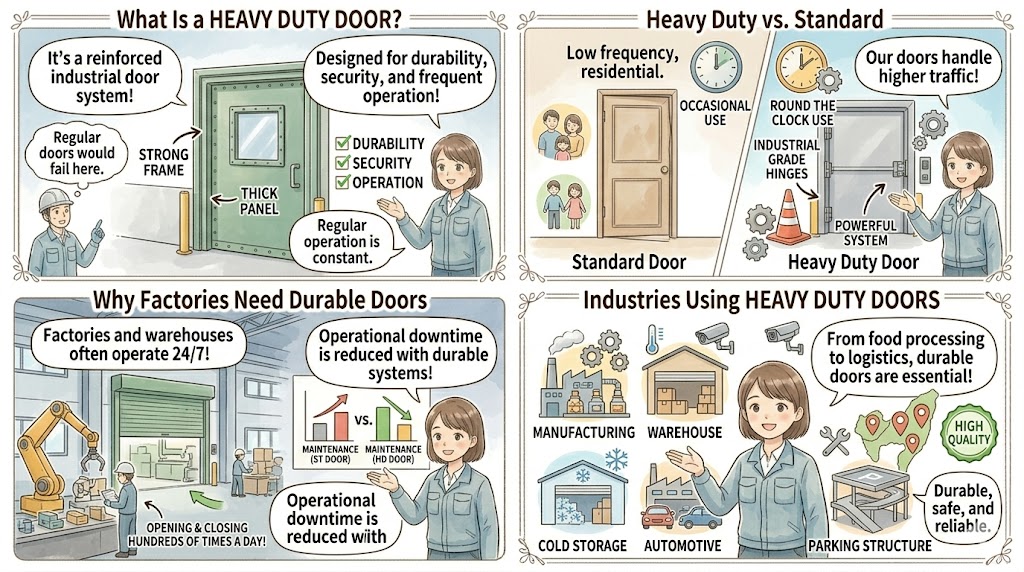
A HEAVY DUTY DOOR is a reinforced industrial or commercial door system designed for durability, security, and frequent operation. These doors are commonly used in environments where standard residential doors would wear out quickly or fail under heavy usage conditions.
The main purpose of a HEAVY DUTY DOOR is to provide reliable access control while withstanding constant opening and closing, physical impact, environmental exposure, and operational stress.
2. What is the difference between a heavy duty door and a standard door?
The biggest difference is durability and structural strength. Standard doors are typically designed for residential or low-frequency use, while heavy duty industrial doors are engineered for commercial and industrial operations.
HEAVY DUTY DOORS usually feature stronger frames, thicker panels, industrial-grade hinges, reinforced tracks, and more powerful operating systems. They are also designed to handle larger dimensions and higher traffic frequency.
3. Why factories and warehouses require durable industrial door systems
Factories and warehouses often operate around the clock, meaning doors may open and close hundreds of times per day. If the door system is not designed for heavy use, operational downtime and maintenance costs can increase significantly.
Industrial door systems also help improve security, workflow efficiency, temperature control, and loading operations in logistics environments.
4. Which industries most commonly use HEAVY DUTY DOORS?
Industries that frequently use HEAVY DUTY DOORS include manufacturing plants, logistics centers, warehouses, cold storage facilities, automotive factories, food processing facilities, pharmaceutical plants, parking structures, and commercial buildings.
Any facility that requires high durability, safety, and operational reliability can benefit from industrial heavy duty door systems.
Section 2: What Types of HEAVY DUTY DOORS Are Available?
1. Steel heavy duty doors and their industrial applications
Steel heavy duty doors are among the most common industrial door solutions due to their durability and impact resistance. They are widely used in factories, loading docks, warehouses, and secure industrial facilities.
These doors can also be customized with insulation, reinforced locking systems, or weather-resistant coatings depending on the environment.
2. Fire-rated heavy duty doors and safety requirements
Fire-rated heavy duty doors are designed to slow the spread of fire and smoke in commercial or industrial buildings. They are commonly required in facilities that must comply with fire safety regulations.
These doors typically use fire-resistant materials and are tested under strict safety standards.
3. Differences between rolling doors, sectional doors, and sliding industrial doors
Rolling doors operate by rolling upward into a compact coil, making them suitable for limited spaces. Sectional doors open vertically using panel sections and tracks, offering better insulation and smoother operation.
Sliding industrial doors move horizontally and are often used in large openings where overhead space is limited. Each type offers different advantages depending on facility layout and operational needs.
4. What features do automatic HEAVY DUTY DOORS provide?
Automatic HEAVY DUTY DOORS improve convenience, efficiency, and workplace safety. Common features include motion sensors, remote control systems, automatic locking, high-speed operation, and smart access integration.
These systems are especially useful in logistics centers, high-traffic facilities, and automated production environments.
Section 3: What Materials Are Commonly Used for HEAVY DUTY DOORS?
1. Galvanized steel vs stainless steel heavy duty doors
Galvanized steel doors are cost-effective and offer strong corrosion resistance for general industrial environments. Stainless steel doors provide higher resistance to rust, moisture, and chemicals, making them suitable for food processing, pharmaceutical, and coastal applications.
The right material depends on operating conditions and environmental exposure.
2. How to choose corrosion-resistant and impact-resistant materials
Facilities exposed to humidity, chemicals, salt air, or outdoor conditions should prioritize corrosion-resistant materials. High-impact environments may require reinforced panels, thicker steel, or protective coatings.
Choosing the correct material can significantly reduce maintenance and replacement costs over time.
3. Does door thickness affect durability and performance?
Yes. Thicker door panels generally provide better durability, impact resistance, insulation, and structural strength. However, thicker materials may also increase door weight and require stronger motor systems.
Balancing durability and operational efficiency is important when selecting specifications.
4. Which materials are suitable for different industrial environments?
Food and pharmaceutical industries often prefer stainless steel for hygiene and corrosion resistance. Warehouses and factories commonly use galvanized steel for durability and cost efficiency.
Cold storage facilities may require insulated panels, while chemical plants may need specialized coatings or chemical-resistant materials.
Section 4: Where Are HEAVY DUTY DOORS Commonly Used?
1. HEAVY DUTY DOOR applications in factories and warehouses
Factories and warehouses use HEAVY DUTY DOORS to support loading operations, protect equipment, improve workflow, and maintain security.
These doors are often installed in loading docks, storage areas, production zones, and logistics entry points.
2. Why cold storage and logistics centers require industrial heavy duty doors
Cold storage facilities require insulated industrial doors to maintain temperature stability and reduce energy loss. Logistics centers require doors capable of handling constant traffic and rapid operation.
Reliable door systems help improve operational efficiency while reducing energy costs.
3. Commercial buildings and parking facilities using heavy duty doors
Commercial buildings and parking structures often use heavy duty rolling doors, sectional doors, or automatic gate systems for security and traffic control.
These doors are designed for frequent operation while maintaining durability and safety.
4. Key considerations for high-frequency door operation environments
High-frequency environments require durable motors, reinforced tracks, quality rollers, and reliable safety systems. Regular maintenance is also critical to prevent downtime and premature wear.
Section 5: How to Choose the Right HEAVY DUTY DOOR?
1. How to evaluate door size and installation space
Door dimensions and available installation space directly affect the type of industrial door system you can use. Ceiling height, side clearance, and opening dimensions should all be evaluated during planning.
Incorrect measurements may lead to installation complications or operational limitations.
2. Why load capacity and usage frequency matter
Doors used frequently or exposed to heavy operational loads require stronger mechanical components and more durable motors.
Choosing a door system designed for the expected workload helps reduce long-term repair and maintenance costs.
3. Do you need automatic sensors and safety systems?
Automatic sensors and safety systems improve convenience and reduce accident risks. Features such as motion sensors, emergency stop systems, and anti-collision protection are increasingly common in industrial environments.
Facilities with forklifts, loading operations, or automated systems especially benefit from these features.
4. Important specifications to check before purchasing a HEAVY DUTY DOOR
Key specifications include material type, insulation performance, fire rating, corrosion resistance, operating speed, motor power, safety systems, and maintenance requirements.
It is also important to confirm whether the door system complies with local building and safety regulations.
Section 6: HEAVY DUTY DOOR Installation and Maintenance Tips
1. Important steps during heavy duty door installation
Proper installation is critical for long-term performance. The frame alignment, track positioning, motor setup, and structural support must all be installed correctly.
Poor installation can lead to operational problems, excessive wear, and safety risks.
2. Why tracks, hinges, and motors require regular maintenance
Industrial doors experience constant movement and vibration, which can wear down moving parts over time. Tracks, rollers, hinges, springs, and motors should be inspected and maintained regularly.
Preventive maintenance helps reduce unexpected breakdowns and extends equipment lifespan.
3. How to troubleshoot noisy or slow door operation
Noisy or slow operation may be caused by worn rollers, poor lubrication, motor issues, track misalignment, or damaged components.
Early inspection can prevent small issues from becoming major repairs.
4. Best practices for extending HEAVY DUTY DOOR lifespan
Regular cleaning, lubrication, inspection, and professional servicing are essential for maintaining industrial doors. Avoid overloading the system and ensure the operating environment remains suitable for the door specifications.
Section 7: Future Trends and Smart Technology in HEAVY DUTY DOORS
1. How smart factories integrate automated industrial door systems
Smart factories increasingly integrate industrial doors into automated production and logistics systems. Doors can now communicate with sensors, warehouse systems, and access control platforms.
This improves operational efficiency and supports fully automated workflows.
2. Why energy efficiency and airtight sealing are becoming more important
As energy costs increase, industrial facilities are placing greater focus on insulation and airtight sealing performance. Well-designed heavy duty doors help reduce air leakage and maintain environmental control.
This is especially important in cold storage, cleanrooms, and climate-controlled facilities.
3. Advantages of remote control and sensor-based door systems
Remote monitoring and sensor-based systems allow operators to track door status, detect faults, and control access from centralized platforms.
These features improve convenience, security, and maintenance management.
4. Future development trends for HEAVY DUTY DOORS
Future HEAVY DUTY DOORS will continue evolving toward smarter automation, stronger materials, improved safety features, better insulation, and predictive maintenance capabilities.
As industrial operations become more automated, door systems will increasingly function as integrated components of smart facility management.
FAQ
Q1: What is a HEAVY DUTY DOOR?
A: A HEAVY DUTY DOOR is an industrial or commercial door designed for high durability, heavy usage, and demanding operational environments.
Q2: What industries commonly use heavy duty industrial doors?
A: Factories, warehouses, logistics centers, food processing plants, pharmaceutical facilities, parking structures, and commercial buildings commonly use heavy duty industrial doors.
Q3: What materials are best for industrial heavy duty doors?
A: Galvanized steel and stainless steel are among the most common materials due to their durability, corrosion resistance, and industrial performance.
Q4: How often should HEAVY DUTY DOORS be maintained?
A: Regular inspections and maintenance are recommended, especially for doors operating in high-frequency industrial environments.
Q5: What is the difference between rolling doors and sectional doors?
A: Rolling doors roll upward into a compact coil, while sectional doors open vertically using connected panel sections along tracks.
Q6: How do I choose the right HEAVY DUTY DOOR for my facility?
A: You should evaluate installation space, material requirements, operating frequency, safety features, insulation needs, and long-term maintenance requirements before selecting a system.
Conclusion
HEAVY DUTY DOORS are widely used in factories, warehouses, logistics centers, and commercial facilities where durability and high-frequency operation are essential. In addition to strength and safety, modern industrial doors are increasingly designed with automation, energy efficiency, and smart control systems in mind.
When selecting a HEAVY DUTY DOOR, businesses should evaluate not only price, but also material quality, durability, maintenance requirements, and long-term operational needs. Choosing the right industrial door system can improve operational efficiency, reduce maintenance costs, and support safer working environments.
 台南防水怎麼做?漏水原因、防水工程與施工完全理解