

What Is a Pneumatic Grease Pump?
A pneumatic grease pump is a grease transfer and dispensing pump powered by compressed air. Instead of relying on manual force, the pump uses air pressure to move grease from a container, drum, pail, or reservoir through a hose, gun, valve, or lubrication line. This makes it especially useful when grease is thick, lubrication points are difficult to access, or the job requires repeated dispensing throughout the day.
In simple terms, the pump converts compressed air into mechanical pumping action. When air enters the pump motor, it drives an internal piston or pumping mechanism that pushes grease through the outlet. Depending on the model, a pneumatic grease pump may be used with standard grease drums, mobile grease carts, centralized lubrication systems, service bays, production equipment, or heavy-duty machinery.
Who commonly uses pneumatic grease pumps?
Pneumatic grease pumps are often used by maintenance teams, automotive workshops, machinery service providers, manufacturing plants, construction equipment operators, agricultural machinery owners, and industrial facilities. Any environment that needs consistent grease delivery can benefit from this type of pump, especially when manual greasing becomes slow, tiring, or inconsistent.
What types of grease can it handle?
The compatible grease depends on the pump design, pressure ratio, air supply, hose length, outlet configuration, and grease viscosity. Many pneumatic grease pumps are designed for common industrial greases, but not every model works well with very high-viscosity grease, long delivery lines, or high-pressure applications. Before selecting a pump, it is important to match the pump capacity with the grease type and working environment.
Why Do You Need a Pneumatic Grease Pump?
A pneumatic grease pump is needed when lubrication work becomes too frequent, too heavy, too inconsistent, or too time-consuming for manual tools. In many industrial and workshop environments, lubrication is not a one-time task. Bearings, joints, pins, bushings, gears, and mechanical assemblies may require scheduled greasing to reduce friction, support smoother movement, and maintain equipment reliability.
Manual grease guns may be acceptable for occasional use, but they can become inefficient when operators need to lubricate many points every day. A pneumatic grease pump helps reduce hand fatigue, improve dispensing consistency, and speed up maintenance routines. It also allows operators to handle grease more cleanly and efficiently when paired with proper hoses, reels, guns, filters, and connectors.
1. It improves lubrication efficiency
When multiple machines require regular greasing, a pneumatic grease pump can reduce repetitive manual pumping. This helps maintenance workers finish lubrication tasks faster while maintaining a steadier grease output. For factories, workshops, and fleet service operations, this can translate into smoother maintenance scheduling and less time spent on routine lubrication.
2. It supports more consistent grease delivery
Consistency matters in lubrication. Too little grease may leave parts under-lubricated, while too much grease may create waste, mess, or excess pressure in certain components. A properly selected pneumatic grease pump helps provide more controlled delivery than purely manual methods, especially when used with appropriate dispensing guns or metering equipment.
3. It is suitable for heavy-duty environments
Heavy machinery, construction equipment, agricultural machines, and industrial production systems often have demanding lubrication requirements. Grease may need to travel through longer hoses, reach hard-to-access fittings, or be dispensed under higher pressure. A pneumatic grease pump is commonly chosen because it can support heavier workloads than basic hand-operated tools.
4. It helps reduce operator fatigue
Repeated manual greasing can be physically tiring, especially when grease is thick or the number of lubrication points is high. By using compressed air as the power source, a pneumatic grease pump reduces the need for repetitive hand pumping. This can improve working comfort and help operators maintain steadier output during long maintenance shifts.
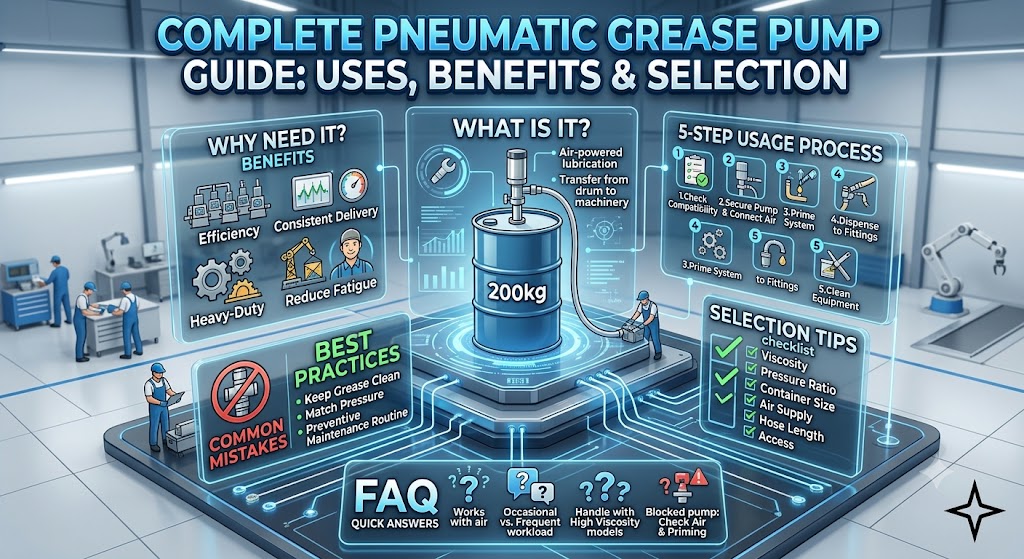
How to Use a Pneumatic Grease Pump in 5 Steps
Using a pneumatic grease pump is not complicated, but the setup should be done carefully. The goal is to ensure stable air supply, correct grease loading, proper connection, safe operation, and clean maintenance after use. The exact procedure may vary by pump model, but the following five-step process applies to many common industrial and workshop applications.
Step 1: Check the grease, container, and pump compatibility
Before connecting anything, confirm that the grease type matches the pump’s working range. Check the grease grade, viscosity, operating temperature, container size, and required output pressure. A pump designed for a small pail may not be suitable for a large drum system, and a low-pressure setup may not perform well when grease needs to travel through long lines.
Step 2: Secure the pump and connect the air supply
Place the pump securely on the grease container or mounting system. Then connect the compressed air line using the correct fittings. Air pressure should be adjusted according to the pump manufacturer’s recommended range. Too little air pressure may cause weak or unstable output, while excessive pressure can increase wear, leakage risk, or unsafe operation.
Step 3: Prime the pump and remove trapped air
Priming helps ensure that grease flows properly through the pump and hose. If air is trapped inside the system, the pump may cycle without delivering grease consistently. Open the dispensing valve or grease gun carefully until grease flows smoothly. This step is especially important after changing grease containers, replacing hoses, or using the pump after a long idle period.
Step 4: Dispense grease at the correct point and pressure
Attach the grease gun, coupler, or outlet nozzle to the lubrication point. Apply grease gradually and monitor the component response. For bearings and mechanical joints, avoid forcing grease aggressively if resistance is unusually high. High resistance may indicate a blocked fitting, hardened grease, damaged line, or incompatible grease path.
Step 5: Release pressure and clean the equipment after use
After finishing the job, shut off the air supply, release residual pressure, clean excess grease around the fittings, and inspect hoses or connections for leakage. Keeping the pneumatic grease pump clean reduces contamination risk and makes the next operation easier. Proper shutdown also helps extend the service life of hoses, seals, couplers, and pump components.
Pneumatic Grease Pump Selection Checklist
Selecting the right pneumatic grease pump depends on your lubrication workload, grease type, pressure requirements, container size, and operating environment. The table below provides a practical checklist for comparing options before purchase or system setup.
| Selection Factor | What to Check | Why It Matters |
|---|---|---|
| Grease viscosity | Confirm compatible grease grade and flow characteristics. | High-viscosity grease may require stronger pumping performance. |
| Pressure ratio | Match output pressure to the application and delivery distance. | Incorrect pressure may cause weak flow or equipment stress. |
| Container size | Check whether the pump fits a pail, drum, cart, or reservoir. | A mismatched setup may cause unstable operation or poor suction. |
| Air supply | Review available air pressure, air volume, and connection type. | Stable compressed air is essential for consistent grease delivery. |
| Hose length | Consider distance from pump to lubrication point. | Longer hoses may require higher pressure and better flow control. |
| Maintenance access | Check how easy it is to clean, inspect, and replace parts. | Easy maintenance reduces downtime and long-term operating cost. |
Common Mistakes When Using a Pneumatic Grease Pump
A pneumatic grease pump can make lubrication work easier, but only when it is selected, installed, and operated correctly. Many performance issues are not caused by pump failure. They are often linked to poor setup, wrong grease selection, air supply problems, or insufficient maintenance.
- Using the wrong grease type: Grease that is too thick or incompatible may reduce flow, increase pump strain, or cause inconsistent dispensing.
- Ignoring air pressure requirements: Unstable or incorrect air pressure can lead to weak output, fast cycling, leakage, or premature wear.
- Skipping the priming process: Air trapped in the system may cause the pump to cycle without delivering grease properly.
- Using damaged hoses or fittings: Cracked hoses, loose couplers, or worn seals can reduce pressure and create messy leakage.
- Over-greasing components: Too much grease may create waste, attract contamination, or increase pressure inside certain assemblies.
- Forcing grease into blocked points: High resistance should be checked carefully rather than solved by simply increasing pressure.
- Neglecting regular cleaning: Dirty equipment can introduce contaminants into grease and reduce lubrication quality.
Best Practices for Better Lubrication Performance
Good lubrication is not only about the pump. It also depends on grease cleanliness, correct pressure, operator training, proper storage, and regular inspection. The following best practices can help improve pump performance and reduce maintenance problems.
1. Keep grease clean from storage to application
Contamination is one of the biggest enemies of lubrication quality. Dust, metal particles, water, and old grease residue can reduce lubrication performance and damage components. Keep grease containers covered, use clean transfer tools, and avoid exposing open grease surfaces to dirty environments.
2. Match pressure to the real application
Higher pressure is not always better. The correct pressure depends on grease viscosity, hose length, lubrication point condition, and system design. Using excessive pressure may hide underlying problems such as blocked fittings or hardened grease paths. Operators should adjust air pressure gradually and monitor system response.
3. Inspect hoses, couplers, and seals regularly
Even a good pneumatic grease pump will perform poorly if the accessories are worn or damaged. Hoses should be checked for cracks, swelling, kinks, and leakage. Couplers should lock securely onto fittings, and seals should be replaced when signs of wear appear. Regular inspection helps prevent sudden downtime.
4. Train operators on proper lubrication amounts
A pneumatic grease pump can deliver grease efficiently, but operators still need to know how much grease each point requires. Over-greasing and under-greasing can both create problems. Clear lubrication schedules, equipment manuals, and visual inspection standards help operators apply grease more consistently.
5. Build a preventive maintenance routine
The pump itself should be part of the maintenance plan. Check air connections, pump cycling behavior, grease output, outlet pressure, hose condition, and overall cleanliness. A simple routine inspection can detect early problems before they turn into production delays or expensive repairs.
Conclusion and Next Step
A pneumatic grease pump is a practical solution for workplaces that need efficient, stable, and repeated grease delivery. It is especially useful in industrial maintenance, automotive service, heavy machinery, production equipment, and any environment where manual greasing becomes slow or inconsistent. By using compressed air as the power source, it helps reduce operator fatigue and improves lubrication workflow.
The best results come from choosing the right pump for the grease type, container size, pressure requirement, air supply, and lubrication distance. Proper setup, clean grease handling, regular inspection, and operator training are just as important as the pump itself.
Next Step: Before purchasing or recommending a pneumatic grease pump, list your grease type, container size, air pressure range, hose length, lubrication frequency, and operating environment. These details will help you choose a pump that fits the actual workload instead of relying only on general specifications.
Pneumatic Grease Pump FAQ
Q1: What is a pneumatic grease pump used for?
A pneumatic grease pump is used to transfer and dispense grease with compressed air. It is commonly used for machinery lubrication, vehicle maintenance, heavy equipment servicing, production line maintenance, and applications that require repeated grease delivery.
Q2: How does a pneumatic grease pump work?
It uses compressed air to drive an internal pumping mechanism. This movement pushes grease from a container through hoses, valves, guns, or lubrication lines, allowing grease to reach machinery parts more efficiently than manual pumping.
Q3: Is a pneumatic grease pump better than a manual grease gun?
It depends on the workload. A manual grease gun may be enough for occasional tasks, while a pneumatic grease pump is better for frequent lubrication, thick grease, multiple lubrication points, and applications where operator fatigue is a concern.
Q4: What air pressure does a pneumatic grease pump need?
The required air pressure depends on the pump model and application. Always follow the manufacturer’s recommended range. Using too little pressure may cause weak flow, while excessive pressure may increase leakage, wear, or safety risk.
Q5: Can a pneumatic grease pump handle high-viscosity grease?
Some models can handle high-viscosity grease, but not all pumps are suitable. You should check the grease grade, pump pressure ratio, hose length, air supply, and outlet configuration before choosing a model for thick grease.
Q6: Why is my pneumatic grease pump not pumping grease?
Common causes include trapped air, low air pressure, incompatible grease, blocked fittings, empty grease container, damaged seals, clogged hoses, or poor priming. Start by checking air supply, grease level, hose condition, and whether the pump has been properly primed.
Q7: How do I maintain a pneumatic grease pump?
Keep the pump clean, inspect hoses and fittings, check seals for wear, use clean grease, release pressure after use, and follow the manufacturer’s maintenance schedule. Regular inspection helps prevent leakage, weak output, and unexpected downtime.
Q8: Can I use any grease with a pneumatic grease pump?
No. Grease compatibility depends on viscosity, base oil, thickener type, operating temperature, and pump design. Using the wrong grease may reduce flow, create clogging, or increase pump wear. Always confirm compatibility before use.
Q9: What should I check before buying a pneumatic grease pump?
Check grease viscosity, pressure ratio, container size, air supply, hose length, dispensing method, maintenance access, and required flow rate. The right pump should match the actual lubrication environment instead of only the lowest price.
Q10: Where are pneumatic grease pumps commonly used?
They are commonly used in automotive workshops, factories, construction equipment maintenance, agricultural machinery service, fleet maintenance, metalworking facilities, and industrial plants that require frequent lubrication of moving parts.
延伸閱讀:
How to choose between Butterfly Valve and Ball Valve?
 Load Cell 是什麼?量測原理、工業應用與選型重點整理